Here we provide a summary of the Financial Services Skills Compact and look at how high-quality digital learning can help companies meet its four commitments.

The Financial Services Skills Compact, launched in July 2026, brings government and employers together to strengthen the sector’s workforce. Its focus is on developing critical skills, sustaining talent pipelines and making progress accountable.
For financial services companies, this creates an opportunity to connect learning investment with practical business needs. How can employees use new technology confidently? Where do teams need stronger analytical skills? And how can learning help people make better decisions when serving customers?
Bespoke digital learning can help answer these questions by giving employees relevant knowledge, realistic practice and feedback they can apply at work.
What are the compact’s four commitments?
HM Treasury published the compact on 14 July 2026. Signatories commit to:
- A: Workforce upskilling. Develop AI and other critical skills across the workforce over a rolling three-year period.
- B: Talent pathways. Maintain or expand structured entry routes for new talent.
- C: Executive accountability. Give a senior executive responsibility for closing skills gaps.
- D: Public reporting. Publish progress annually.
Initial reporting is due by 30 November 2026. Firms select up to five critical skills, including AI. Measurement counts unique UK employees upskilled, rather than course totals.
High-quality digital learning can qualify. However, mandatory training, including required compliance and induction, is excluded from Commitment A. Ordinary onboarding alone does not qualify under Commitment B; structured pathways include apprenticeships, graduate programmes and returner schemes.
Full definitions and reporting requirements appear in the government’s Financial Services Skills Compact guidance. The Financial Services Skills Commission (FSSC) supports reporting.
Start with the skills employees need to apply
A useful skills assessment begins with the work people need to perform. Course catalogues and self-assessment surveys can contribute, but they should sit alongside evidence from managers, quality reviews, customer feedback and practical assessments.
For example, a customer service adviser may understand a product yet struggle to navigate several systems while explaining it. An analyst may produce a report without confidently questioning the data behind it. A manager may know what generative AI does but need practice evaluating its output.
Each gap calls for a different learning response. Employers should define an observable outcome, such as completing a workflow accurately, interpreting financial information or recognising when an AI-generated answer needs further checking.
A sensible starting point is to prioritise gaps according to their impact on customers, operational performance and planned technology changes. Establishing a baseline before training also makes it easier to judge whether the investment has helped.
Use digital learning to build practical capability
Digital learning works best when employees can connect it directly with their responsibilities. Rather than giving everyone an identical learning journey, companies can combine shared foundations with activities tailored to different roles.
Build confidence with AI and data
A practical AI learning programme could ask employees to review a generated customer response, identify unsupported claims and improve the result using approved information. Data exercises could involve interpreting a dashboard, spotting missing context or explaining findings to a colleague.
These activities should reflect the organisation’s approved tools and policies. Managers can then reinforce learning through supervised workplace tasks and discussion.
The aim is to build judgement alongside technical familiarity, so employees understand when technology is useful and when human review is essential.
Let employees practise software workflows
Software demonstrations show employees what a system looks like. Simulations let them practise using it.
A realistic learning environment can reproduce a customer enquiry, require the learner to find information across several screens and ask them to record an appropriate action. Feedback can explain both the system steps and the reasoning behind them.
This approach is particularly useful when introducing new software or helping colleagues use existing technology more effectively. Training should cover complete tasks, including exceptions and handovers, so employees understand how individual features support the wider workflow.
Connect knowledge with customer conversations
Financial services performance depends on communication as well as technical accuracy. Scenario-based activities can ask employees to explain a complex process, respond to uncertainty or recognise when a case needs escalation.
Combining a conversation with a simulated system task creates practice that reflects the demands of the job. Learners can develop the ability to listen, make decisions and document their work together.
Compliance specialists should help validate relevant content. Well-designed training can support compliant behaviour, while operational supervision and controls remain essential.
Reinforce learning over time
Short refresher activities, searchable job aids and manager coaching can help employees revisit difficult tasks after their initial training.
Employers should also provide protected learning time and accessible content. Digital delivery offers flexibility, but employees still need the opportunity and support to engage with it.
Support talent pathways and demonstrate progress
For apprentices, graduates and career returners, digital learning can provide a consistent foundation while allowing additional practice where needed. Employers could combine online modules and simulations with mentoring, supervised assignments, study time and regular development reviews.
The learning journey should extend beyond a new starter’s first weeks. Clear milestones help learners and managers understand how capability should develop as responsibilities grow.
Executive sponsors need a similarly clear view of delivery. A practical dashboard could show priority skills, participation, assessment results, unresolved gaps and agreed actions. Learning teams should work with HR and reporting colleagues to establish reliable employee identifiers and avoid double-counting people.
Alongside participation data, employers should assess relevant performance measures. These might include fewer processing errors, improved task accuracy, reduced rework or faster progression to independent working. Comparing these with the baseline helps distinguish attendance from useful development.
Day One’s experience in financial services digital learning
Day One Technologies creates bespoke financial services elearning for banks, building societies, insurers and accounting organisations. Its experience includes onboarding, software adoption, customer service, compliance and employee development.
Our Learning By Doing approach combines tailored content, scenarios and system simulations. Working with client subject matter experts, Day One develops learning around the systems, processes and decisions employees encounter in their roles.
The following projects demonstrate our financial services digital learning experience…
Lloyds and HBOS: Preparing employees for a systems transition
Day One’s systems simulations supported contact centre preparation for a major banking software transition.
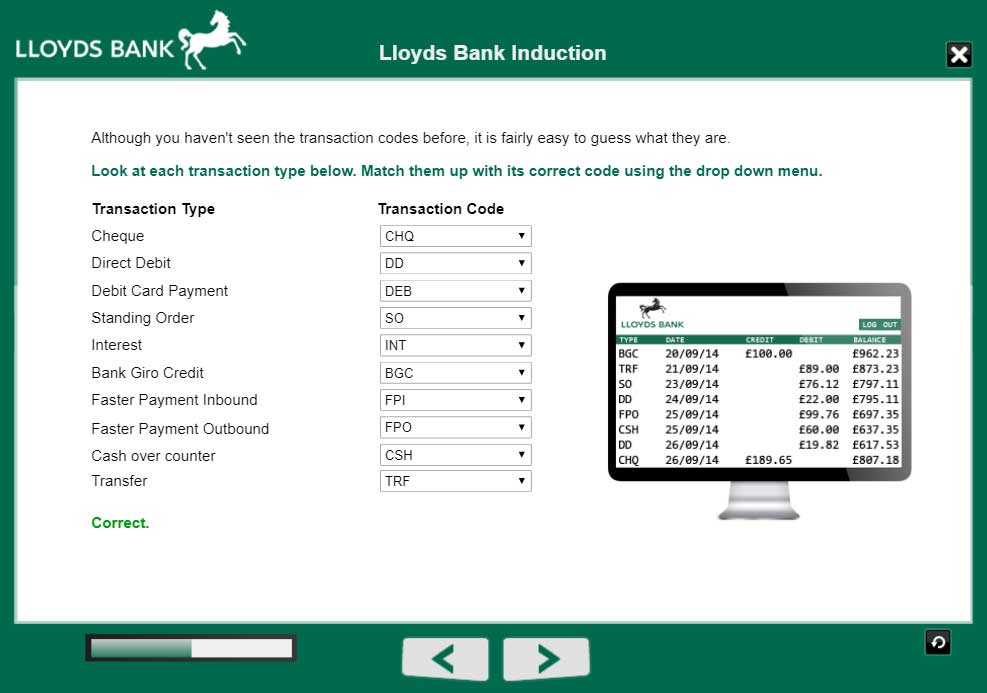
The simulations formed part of a blended learning programme and were used by up to 600 delegates a day ahead of the switch. They helped advisers maintain familiarity with the software and build confidence before using it with customers, and with no downtime or loss of customer care quality.
This illustrates how digital practice can support technology adoption at scale.
Read the Lloyds and HBOS systems training case study.
Coventry Building Society: Engaging employees with sustainability
Coventry Building Society wanted its first company-wide sustainability awareness learning to support its environmental ambitions. Because participation was optional, engagement was central to the brief.

Day One worked with stakeholders and subject matter experts to create mobile-friendly learning using scenarios, gamification, short videos and practical tips. Learners could explore the content with support from an employee avatar.
The case study shows how bespoke learning can make a developing business priority accessible and relevant.
Read the Coventry Building Society case study.
Baker Tilly: Developing analytical skills through business simulations
For Baker Tilly US, Day One created financial stewardship learning built around realistic investment scenarios.

Working with subject matter experts, the team developed fictitious financial profiles and company reports for learners to analyse. Interactive business simulations combined detailed decision-making activities with elements of competition.
The initial rollout reached hundreds of US consultants and the project offers an example of learning designed around the application of financial knowledge and analytical judgement.
Read the case study on business simulations for Baker Tilly.
Lloyds Banking Group: Stronger onboarding and workplace performance
Lloyds Business Banking needed to improve contact centre induction, with 20% of recruits leaving before completing the programme.

Day One created a simulated environment with desktop system mock-ups, realistic scenarios and built-in assessments. Trainees could practise complex banking processes while trainers identified where individuals needed additional support.
Outcomes included induction attrition falling from 20% to 5% – a 25% improvement in new advisers’ ability to resolve a query in one interaction, and average after-call work falling from two minutes to 45 seconds.
The project demonstrates how realistic practice can connect technology competence with customer service and operational performance.
Read the Lloyds Banking Group onboarding case study.
New project: Supporting a global bank with cyber security training
Following the success of risk management training for thousands of financial services employees at one of the world’s largest banks, we are now supporting them with a cyber security elearning project. This will of course include content on the latest risks that are amplified by AI.
Turn the four commitments into practical action
Day One can help financial services employers plan and deliver learning that supports their response to the compact: targeted skills development for Commitment A, learning within structured talent pathways for Commitment B, evidence to inform executive oversight for Commitment C, and learning records and evaluation to support reporting for Commitment D.
Employers retain responsibility for their recruitment pathways, executive appointments and public disclosures. Day One’s role is to help make the learning behind those commitments relevant, engaging and measurable.
Whether the priority is AI capability, confident software use, stronger analytical skills or developing new talent, get in touch with Day One Technologies to discuss how bespoke digital learning can help your financial services organisation close skills gaps and meet the compact’s four commitments.